Some New Things
Parading Forward: Vernacular Memorialization and Communal Grief on Bourbon Street
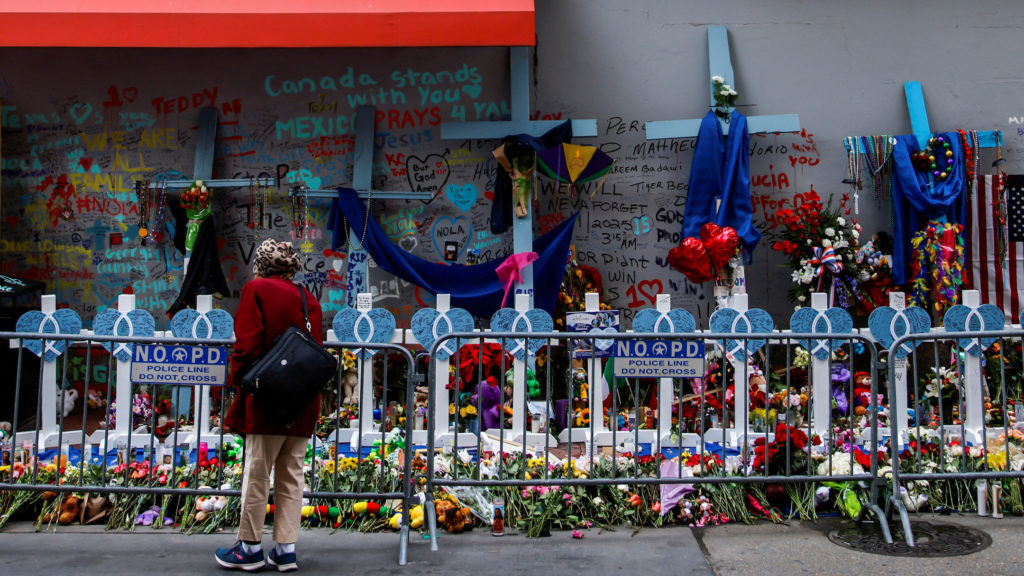
While formal monuments and memorials, like the Vietnam Veterans Memorial (VVM) in Washington, D.C., or the Oklahoma City memorial remembering those affected by the bombing of the Alfred P. Murrah Federal Building on April 19, 1995, typically take years to develop and build, informal or vernacular memorials often materialize within days if not just a few hours of a tragic event. These spontaneous acts of memorialization made by everyday people living within the affected community are what I find to be most engaging—more specifically, the vernacular memorial erected by the people of New Orleans, Louisiana, honoring those killed in the terror attack on Bourbon Street during the early morning hours of New Year’s Day, 2025.
Formal memorialization of the deaths of ordinary people only became a thing recently. Historically, aside from war memorials, monuments were mostly about honoring the past, whereas more contemporary memorials honor the dead; even then, memorials tended to commemorate elite individuals—those being aristocrats and military leaders (Sparling 35). Over the course of the twentieth century, though, memorials have increasingly been created to commemorate “average, everyday people, such as settlers, miners, oil-rig workers, and the rank-and-file in police and rescue organizations” (Sparling 35). It is theorized that “this shift toward memorialization of everyday people encouraged everyday people themselves to create memorials, rather than waiting for authorities to do so,” reflecting the democratic value of self-governance present in American society (Sparling 35).
Vernacular forms of memorialization, I think, are the most authentic demonstrations of remembrance, as they emerge in the immediate aftermath of a tragedy when emotions are at their rawest and “the overwhelming empowerment of grief” is at its strongest (Osterholtz 234). These memorials escape institutionalization, as they are not officially sanctioned or maintained by a governmental agency; rather, they occur as interactive expressions of communal grief to which anyone who feels compelled can contribute, forever changing the space the memorial temporarily occupies (Osterholtz 234). Very rarely is there an exchange of permission between city officials and those who initiate the formation of a spontaneous memorial. As the erection of such shrines has become more common, so has the understanding of the act as an essential part of the healing process for a community recovering from a tragic event.
“Makeshift” memorialization—a term often used in popular discourse when referring to vernacular memorialization—is disputed by scholars for its disparaging connotation and disregard for the thoughtful detail put into creating an informal memorial site. Margaret Yocom argues, “There is nothing makeshift about them. These places where people visit, linger, and sit for hours in silent contemplation have a rhythm, a precision, an aesthetic arrangement, and a set of behaviors all their own” (Yocom 61). Harriet Senie agrees that “referring to the array of objects that people leave to mark the place of death as ‘makeshift’ belittles the poignancy of individual contributions as well as the visual and emotional power of the whole” (Senie 40). “Vernacular” memorialization grants these sacred sites the respect they deserve and recognizes the domestic creation of a site by the community as happening at the grassroots level.
Harper Sparling debates whether describing vernacular memorialization as “spontaneous” fails to appreciate the rhyme and reason behind the mortuary practice itself, since “memorials that might appear to be spontaneous are actually somewhat circumscribed by precedent” (Sparling 41). Because vernacular memorialization is a relatively new convention, surging in the 1980s, the terminology surrounding the phenomenon is not yet standardized. The practice of adorning burial sites with personal mementos or leaving flowers or candles at a person’s resting place, the basic building blocks of vernacular memorialization, however, is not a recent development, spanning some 13,700 to 11,700 years back to the age of prehistoric peoples in Mount Carmel, Israel. (Yeshurun 2013). The lineage of vernacular memorialization, while incredibly interesting, is not the focus of this essay though. Rather, the aspects of communal empathy and cultural identity that shine through acts of vernacular memorialization are what I would like to hone in on with regard to the goals of this portfolio.
I will be using the informal shrine erected following the terror attack on Bourbon Street, partly due to personal relevancy as having grown up in Louisiana, as a case study to discuss these two elements in addition to the shrine’s unique condition as a roadside memorial in honoring the fourteen innocent people killed, including a mutual friend of mine, Kareem Badawi, in an act of vehicular manslaughter by the truck-driving assailant last New Year’s Day. The New Orleans community is one of considerable resiliency, having endured a great deal of devastation in the events of Hurricane Katrina (2005), the Deepwater Horizon oil spill (2010), too many mass shootings to count, and now this attack on the city’s most famous and widely visited nightlife corridors; what’s more frustrating is that the level of devastation experienced in these events was largely preventable (Larose 2025). But through it all, the people of New Orleans and the greater community of Louisiana have paraded forward, literally, past these tragedies that seem inherent to life in the bayou.
If a person saw the memorial following the attack on Bourbon Street (featured in the image above), having not known what it was, they might’ve thought it to be a remnant of or a precursor to the celebration that takes place during Mardi Gras season, which really lasts year-round in New Orleans. Parade barricades, regularly used as measures of crowd control, are a common sight in New Orleans, as are temporary, outdoor art installations, typically found in the vicinity of the French Quarter. In the case of the memorial, though, the parade barricades are used to protect the site from harm after its completion. In addition to the usual flowers, notes, poems, CDs, pictures, and candles, among other items of personal significance, are Mardi Gras beads and other parade throws—items commonly tossed by people on parade floats to the parade-goers lining the streets below, including stuffed animals, artificial flowers, purple, green, and gold parasols, plastic doubloons, and light-up toys. If you look closely, you can also see empty bottles of Louisianian liquor, most noticeably Taaka vodka, as well as daiquiri vessels, a customary souvenir often obtained from one of the bars on Bourbon Street.
Most obvious are the wooden crosses, both the larger, more vibrantly painted crosses leaning against the wall in front of which the memorial is situated, and the smaller white crosses donning light blue hearts crafted by the members of Lutheran Church charities trained in spiritual first aid, who were mobilized to New Orleans shortly after the attack (Kerth 2025). Their immediate dispatch to New Orleans, along with Texan “disaster artist” Roberto Marquez’s journey to New Orleans and contribution of a mural to the memorial (Fuentes 2025), speaks to the multi-communal call for action in the wake of a tragedy. The wooden, hand-painted crosses at the memorial site share a resemblance to the roadside crosses marking a victim of vehicular homicide’s place of death commonly seen driving along the highway. I thought this to be worth mentioning because the attack on Bourbon Street was one of mass vehicular manslaughter, as New Orleans officials failed to take backup measures after removing the portable steel posts on Bourbon Street designed to deter vehicles but allow pedestrian access (Larose 2025). In this way the memorial on Bourbon Street acts as a mass roadside memorial.
In memorializing the lives of those killed that night on Bourbon Street, the lively people of New Orleans convened for a vigil—”a public display of personal grief” (Osterholtz 237)—the Saturday following the attack. New Orleans street performers put on colorful dances to the tunes of jazz musicians as families and friends privately grieved the lives of their loved ones and community members added to the memorial, positioned at the corner of Canal Street and Bourbon Street, not far from the original site of the atrocity. “The physical act of constructing a spontaneous shrine often helps the mourner symbolically reconstruct his or her own life and the absence of the departed,” says Anna Osterholtz (Osterholtz 234). This act of creating something so beautiful, a memorial or a vigil, for instance, in a space that saw such horror works to redeem the final moments of the lives harmed and aid the bereaved in their healing processes. The vigil allowed for those affected to “contribute through labor or material objects to [the] communal grief” taking place (Osterholtz 234), highlighting the importance of the actual exercise of creating a memorial space.
Fuentes, Andrés. “New Orleans Relocates Bourbon Street Memorial for Preservation.” https://www.fox8live.com, 21 Feb. 2025, www.fox8live.com/2025/02/21/new-orleans-relocates-bourbon-street-memorial-preservation.
Kerth, Maddie. “14 More Memorial Crosses Are Now on Bourbon St; Meet the Team Who Made Them.” https://www.fox8live.com, 6 Jan. 2025, www.fox8live.com/2025/01/06/14-more-memorial-crosses-are-now-canal-st-meet-team-who-made-them.
Larose, Greg. “Quit Asking New Orleans to Be Resilient. We Just Want Accountability.” Louisiana Illuminator, 5 Jan. 2025.
Osterholtz, A. “Modern Memorialization: Vernacular Memorials.” The Bodies Poetic, Bioarchaeology and Social Theory, doi.org/10.1007/978-3-031-85998-4_12.
Smithsonian Insider – Funeral Flowers in the Stone Age: Q&a With Smithsonian Anthropologist Reuven Yeshurun | Smithsonian Insider. 28 Sept. 2013, insider.si.edu/2013/09/28455.Sparling, Heather. Formal Memorials, Vernacular Memorials, and Disaster Songs. pp. 30–32. https://doi.org/10.4324/9781003218494-2.
A Walk in Someone Else’s Shoes
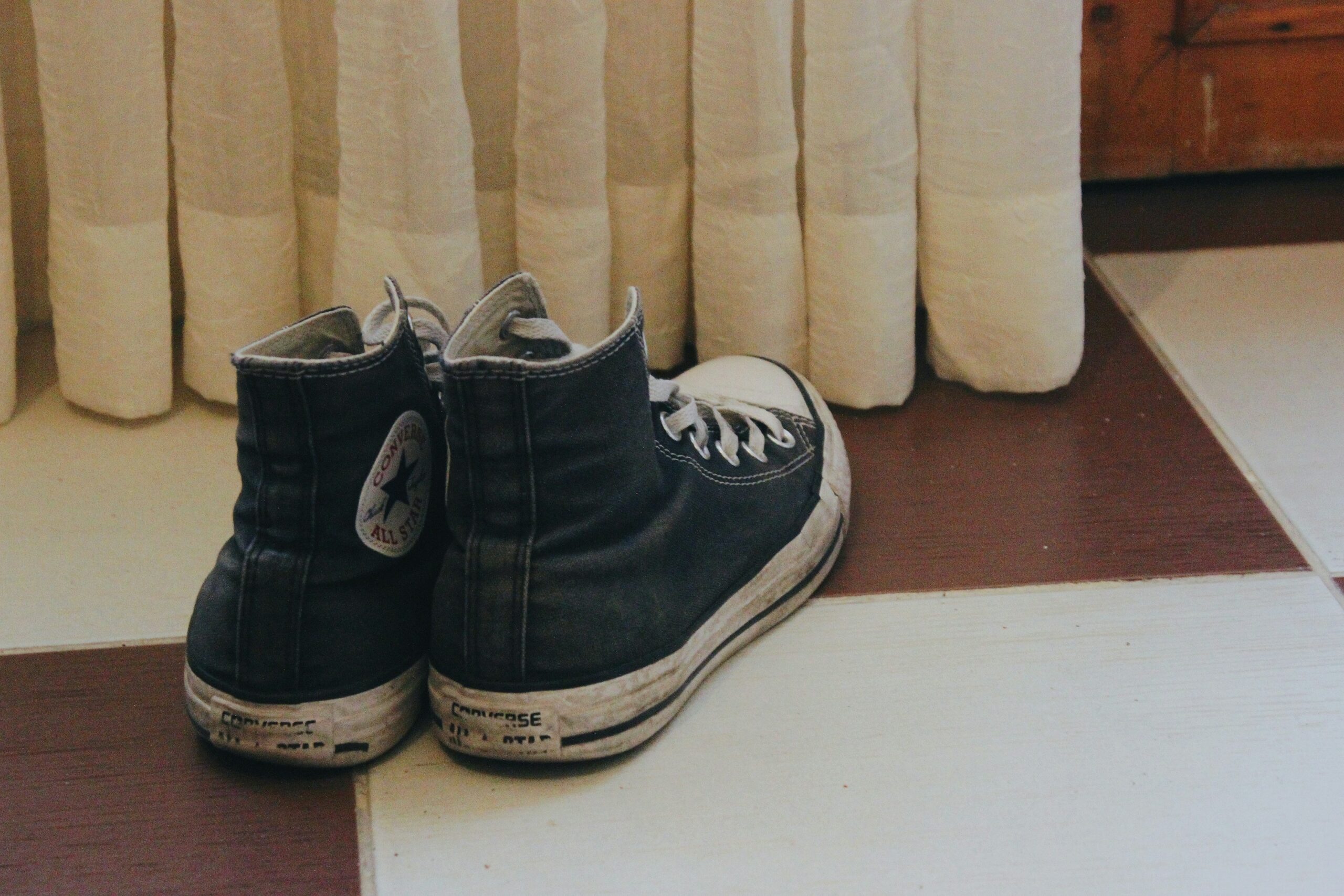
Chloe Butler’s shoes
Taddeo Simon’s shoes
Declan Lonergan’s shoes
Hunter Pearson’s shoes
Reyna Mehta’s shoes
As my portfolio focuses on empathy within justice, I decided to take a walk in five of my classmates’ shoes for my Something New nontextual with an aim to understand more about where they come from. Most of what was shared by my classmates, I would have never known until walking that mile in their shoes. I was surprised by my ability to relate so well to people I have only known for a few short months.
Many of my participants were concerned about whether or not we would fit in each other’s shoes; however, the physical discomfort experienced while walking in shoes that may not fit perfectly was an intentional part of the exercise, as it allowed for a better understanding of the personal inconveniences or hardships being discussed. The trading of shoes also represented an exchange of the places we had been—a physical wearing of the other person’s lived experiences.
In this exercise I learned more about others’ everyday thought processes, cultural differences, social dispositions, and perceived responsibilities—qualities that had not been apparent to me until that meaningful conversation and switching of shoes. I also realized just how common certain difficulties are amongst people of entirely different backgrounds, which gave me a lot of hope moving forward. If we can all work a little harder to better understand where people of opposing viewpoints are coming from, I think finding common ground, politically, religiously, and socially, might actually be attainable.
Growing Pains
Throughout this second semester, I have felt a reluctance towards growing up. In a matter of months I will be twenty years old. The picture I chose for the cover of this playlist captures this reluctance to grow up. It was taken right before my brother was born. I strapped myself into the changing table pad, demonstrating my desire to stay little and communicating my anxiety about becoming a big sister. This picture is still relevant today. I am again experiencing this nostalgia for childhood and unwillingness to transition into adulthood. I want to be a teenager forever. This playlist grapples with the tensions of transitioning from childhood, to adolescence, to young adulthood. The first several songs, including “Banana Pancakes” by Jack Johnson and “Puff, the Magic Dragon” by Peter, Paul, and Mary, emulate the magic and innocence of the childhood my parents provided me. “1979” by The Smashing Pumpkins signifies my growing up and becoming a ‘big kid,’ a stage of childhood characterized by newfound freedom and responsibility as a big sister to several siblings. “Ribs” by Lorde marks my transition into adolescence, communicating my desperation for independence and desire to rebel. I was taught by my parents to be patient, hence “Patience” by Tame Impala. The next several songs recall the trials and tribulations of this stage of my life, marked by personal struggles of acceptance and self-love. “In My Room” by the Beach Boys brings to mind the amount of time I spent alone in my bedroom, which functioned as both a sanctuary and a cave to which I often retreated. At the time, it felt like the only safe place in the world. I don’t often like to reflect on my early teenage years, although they taught me a lot about myself. “Changes” by David Bowie alludes to the beginning of my journey towards self-acceptance and reconciliation, which I didn’t embark on until very recently. Being away from home for college has given me a greater appreciation for my family than I could have imagined. In some ways, the distance actually brought us closer. The last few songs of the playlist reflect my current state, which involves a hatred for the passage of time, a longing for childhood, immense gratitude, as well as anxieties about the future and the weight of adult responsibilities. The tone of this playlist is definitely bittersweet, but curating it was a wonderful meditative activity. I hope you can relate as you listen.
Justice as Understood by a Third-grader: A Collaboration
For this something new, I collaborated with my second and third grade students enrolled in the after-school program at the Ada Jenkins Center. I have had the privilege of learning alongside them this semester, and although I am the official instructor, they have taught me some valuable lessons that I have forgotten since I was their age: the importance of playtime, the power of imagination, and the shock of brutal honesty. In thinking about how I wanted to define justice in this portfolio and in light of re-reading Le Petit Prince, I came to understand that what I was missing was the perspective of someone younger and more optimistic than myself, for I was acting far too “grown-up” in my approach to justice—asking questions that I thought were pointed but ended up just being shallow iterations of questions I’d heard important people pose, much like the adults in Le Petit Prince:
“Grown-ups like numbers. When you tell them about a new friend, they never ask questions about what really matters. They never ask: ‘What does his voice sound like?’ ‘What games does he like best?’ ‘Does he collect butterflies?’ They ask: ‘How old is he?’…‘How much money does he have?’… If you tell grown-ups, ‘I saw a beautiful red brick house, with geraniums at the windows and doves at the roof…,’ they won’t be able to imagine such a house. You have to tell them, ‘I saw a house worth a thousand francs.’ Then they exclaim, ‘What a pretty house!’” (Saint Exupery 10).
I was so focused on asking the “right” questions that I wasn’t asking meaningful ones. There are endless interpretations of justice, none of which are “right” or “wrong.” But I was curious to know how a group of twelve 10-year-olds would interpret its meaning, since none of us “adults” can come to a clear consensus. Asking them flat-out to define justice seemed a little daunting, so I did exactly what my professors do—assign a reading. Well, technically, I read to them, but same idea. I decided on one of my favorite books—Where the Wild Things Are by Maurice Sendak—to act as the basis for our conversation about justice. I knew this story would be one that my students could relate to but also one that would provide meaningful talking points.
If you are unfamiliar with Where the Wild Things Are, here’s how the story goes: A young boy named Max who, after dressing in his wolf suit, wreaks such havoc through his household that he is sent to bed without his supper. Shortly after, Max’s bedroom transforms into a jungle, and a small boat appears. He sails to a farawar island inhabited by monsters—the Wild Things—who try to scare Max, but fail. The monsters are impressed by Max’s courage and make him the king of the Wild Things. As King, Max enjoys a playful romp with his subjects, and eventually sends them to bed without supper, just as he was. Soon after, Max begins to feel lonely and decides to sail home. Upon returning to his bedroom, which is no longer a jungle, Max discovers supper waiting for him, still warm (Sendak 48).
I read to my students from a spot on the rectangular rug rather than in a chair, which can feel like a pulpit at times. My goal was for them to view me as something less formal than a teacher in this activity. By descending to the floor to inhabit the same space on the rug as them, I automatically improved trust. At once, we were at the same eye level and bodily composition—criss-cross-applesauce, shoes off, reading together on the rug. I was also intentional about how I posed questions I prepared for the discussion. Instead of pausing to ask questions and disrupting the flow, I wove them into my reading of the text. This allowed for the discussion to feel naturally embedded, rather than externally performed. If the conversation shifted away from the original question, I let it. The last thing I wanted was for my students to feel as though they were being interrogated.
There were several things that stood out to me about our conversation, the first being my students’ immense empathy for Max. In the story Max’s mother calls him a “wild thing” for the mischief he’s caused, and Max responds “I’ll eat you up!” demonstrating a child’s likelihood for oppositional or defiant behavior (Sendak 5). As the oldest of four, I was always careful about what I called my siblings, whether it be “annoying” or “bad” or “weak,” because I knew that by calling them something, they were more likely to repeat that behavior just to prove me right. It’s the same thing in the classroom; the more I ask one of my students not to do something, the more they want to do that thing. In our conversation, I asked my students to confirm whether my observation was true, and they did. Macy, one of my third grade students, defended Max, arguing that he was only living up to his mom’s expectations.
In lieu of Max sailing away to the island of the Wild Things, I asked the class if they had a place they considered to be a sanctuary—somewhere they could escape to when their emotions felt too big. Many students said they retreat to their backyard or their bedroom when in need of a place faraway from everything else. Others said they escape to “worlds in books.” I asked them why these places felt safe. Many expressed that they liked the privacy and quietness of their bedrooms. Those that mentioned their fondness for their backyard, said that being outside calmed them and allowed for “better pretend-play than inside.” I related most to the students who mentioned reading as a means of escape. I shared a room with my sister until coming to college, so I didn’t always have the privacy and solitude so many of the students talked about, but I did have an extensive collection of fantasy and dystopian books that I often relied on.
Next, we talked about the differences between Max’s bedroom at home and his place on the island. Several students pointed out that at home, Max’s mom was in charge, but on the island Max held all the power. At home, Max’s “wild” behavior was condemned, but on the island his wild behavior earned him the title of King of the Wild Things. Max also felt that he belonged on the island, among other wild creatures, whereas at home, he was constantly being corrected and made to feel bad about his behavior. He got to stay up late on the island and dictate the wild things’ bedtime, whereas at home, he was told when to go to bed. Ultimately, Max created an (imaginary?) world for himself where justice prevailed, unlike at home where he was constantly being policed and forced to follow unnecessary rules—or rules that he believed to be unfair.
To close our discussion, I asked them one final question: was it fair that Max was given dinner despite his bad behavior? My class unanimously agreed that it was right of Max’s mother to feed him dinner, but she also should have talked to him about his behavior rather than just threatening to withhold food. Two of my second grade students, Messiah and Jase, argued that Max would simply repeat the same behavior if his mother didn’t explain why it was bad—just that it was unacceptable. Another student, Ximena, interjected, claiming that Max’s behavior was probably already repetitive, and that his mother knew he just needed “quiet time” to collect himself. The whole class agreed that it would not have been kind of his mother to send him to bed without food, though, because withholding food has nothing to do with him acting out. “His punishment should be something more meaningful,” Ellie asserted.
Children’s obsession with fairness and equality, especially when things are skewed in an unfavorable direction, is something that I think we can all learn from. They have very little tolerance for inequality—much less tolerance than most adults who at this point have accepted that “life just isn’t fair.” If we mirrored children’s stubbornness to accept unfairness and their willingness to publicly identify it, we would likely be in a much better position than we are today. When justice is at stake, don’t take no for an answer. Throw a fit. Roar. Be loud and “wild” in your demand for something better.
Saint-Exupéry, Antoine de. The Little Prince. Translated by Katherine Woods, Harcourt, 1943. Sendak, Maurice.
Where the Wild Things Are. Harper & Row, 1963.
Liberty Is Losing Blood
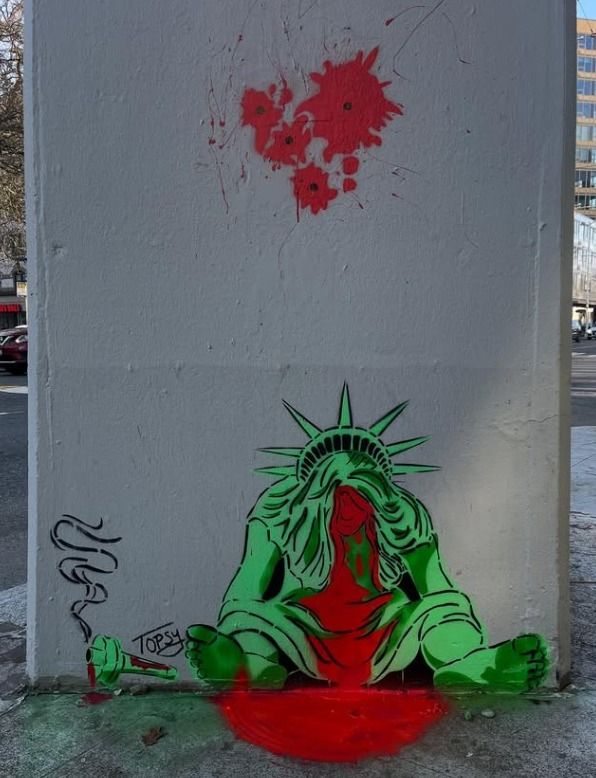
On January 19th, shortly after United States Immigration and Customs Enforcement (ICE) opened fire on Renée Good, a mural appeared on the corner near 500 Denny Way in downtown Seattle. Signed by Topsy—an anonymous, uncommissioned public artist who has made it their mission to create provocative, stencil-style protest art confronting the abuses of ICE. In this way, Topsy functions as a present-day American Banksy, using the streets as a canvas for dissent. The work operates as political commentary, vernacular memorial, and urgent warning to the people of the United States.
The placement of the mural is no accident. Positioned directly outside a U.S. Immigration & Citizenship Law firm, the mural lands in the path of the very people most affected by the policies it critiques: migrants, refugees, and their families who walk through that door seeking legal protection. This places the “human cost” of legal proceedings directly in the path of those experiencing them. Topsy makes the work impossible to dismiss, as the mural is painted in searing green and red. The office cannot be entered without first walking past it.
Above her, four bullet holes punctuate the wall, their splattered red paint rendered with a realism that stops pedestrians cold. The four shots recall the four bullets fired at Renée Good—a queer, 37-year-old American writer, poet, and mother of three killed by ICE. Here she is personified by Liberty herself, the mural acting as both a tribute and a memorial to Good and everything she stood for.
The wounded Lady Liberty slumped in the corner of the building, head hanging, body crumpled, her torch extinguished—a posture that could not be further from her iconic form: erect, shoulders square, torch raised as a beacon of hope for nearly 14 million immigrants who arrived on American shores between the years of 1886 and 1924 (Doorway to America). Positioned in New York Harbor, it was the first major U.S. landmark seen by immigrants passing through the nearby Ellis Island processing facility. She represented freedom, hope, and the promise of a new life. Therefore, Topsy’s depiction of her death symbolizes the end of the U.S. being seen as a place of hospitality for immigrants.
At the base of the original statue, a bronze plaque bears the words of Emma Lazarus’s 1883 sonnet “The New Colossus,” which christened Liberty the “Mother of Exiles” and issued her famous invitation: “Give me your tired, your poor, your huddled masses yearning to breathe free” (The New Colossus). Lazarus wrote the poem to raise funds for the statue’s pedestal; it was engraved and installed in 1903, seventeen years after her death. That invitation now appears to have been revoked at gunpoint.
Online commenters have responded to the mural in ways that speak to the absurdity of ICE’s justifications for their violence. Responses include jokes that the agency would claim Lady Liberty “drove a car at them,” that she was “wielding a torch in a threatening manner,” or that she “turned out to have French ancestry and couldn’t produce legal paperwork.” The sardonic humor lands because it mirrors the actual logic used to justify real enforcement actions, and because it makes plain how hollow those justifications are when applied to the very symbol America erected to welcome the world.
Lady Liberty’s blood pools bright red beneath her and onto the sidewalk—a formal choice that dissolves the boundary between image and reality. The mural asks an uncomfortable question of every idle passerby: what does it mean that the symbol of American freedom is the one bleeding out? Liberty is losing blood quickly. If we don’t act, there may be nothing left to revive.
“‘The New Colossus’: Emma Lazarus and the Immigrant Experience.” Gilder Lehrman Institute of American History, https://www.gilderlehrman.org/history-resources/essays/new-colossus-emma-lazarus-and-immigrant-experience. Accessed 11 May 2026.
“Doorway to America.” National Archives Foundation, 16 Jan. 2024, https://archivesfoundation.org/newsletter/doorway-to-america/.
